Date
Introduction
When people start looking for real night vision, one name comes up again and again: PVS-14.
It is not the newest night vision device. It is not the fanciest one. It is not the cheapest one either.
But somehow, PVS-14 is still one of the most popular starter NVGs on the market.
Why?
Because it works. It has a mature design, wide accessory support, and a clear product position. For many buyers, it is the first step from “night vision toy” to real image intensifier night vision.
In this review, we will look at what a PVS-14 is, why it still offers good value, how it compares with cheap toy-style devices, and what buyers should check before placing an order.
No hard words. No confusing lab talk. Just a simple review for real buyers.
1. Why PVS-14 Is Still a Popular Starter NVG
The PVS-14 has been around for many years, but it is still far from outdated.
For beginners, this is actually a good thing.
A mature product usually means fewer surprises. The structure is well known. The accessories are easy to find. Many users already understand how it works. For dealers and wholesalers, this also makes the product easier to explain and sell.
A PVS-14 can be used in several ways:
- Handheld for simple observation
- Helmet-mounted for hands-free use
- Mounted with accessories for different setups
- Used as a basic night vision training or demo device
This flexibility is a big reason why many buyers still start with PVS-14.
It is like the “classic white shirt” of night vision. Not the loudest item in the room, but always useful.
For B2B buyers, PVS-14 also has another advantage: customers already know the name. That means less education work and a shorter decision path.
2. A Quick Look at the PVS-14 Structure
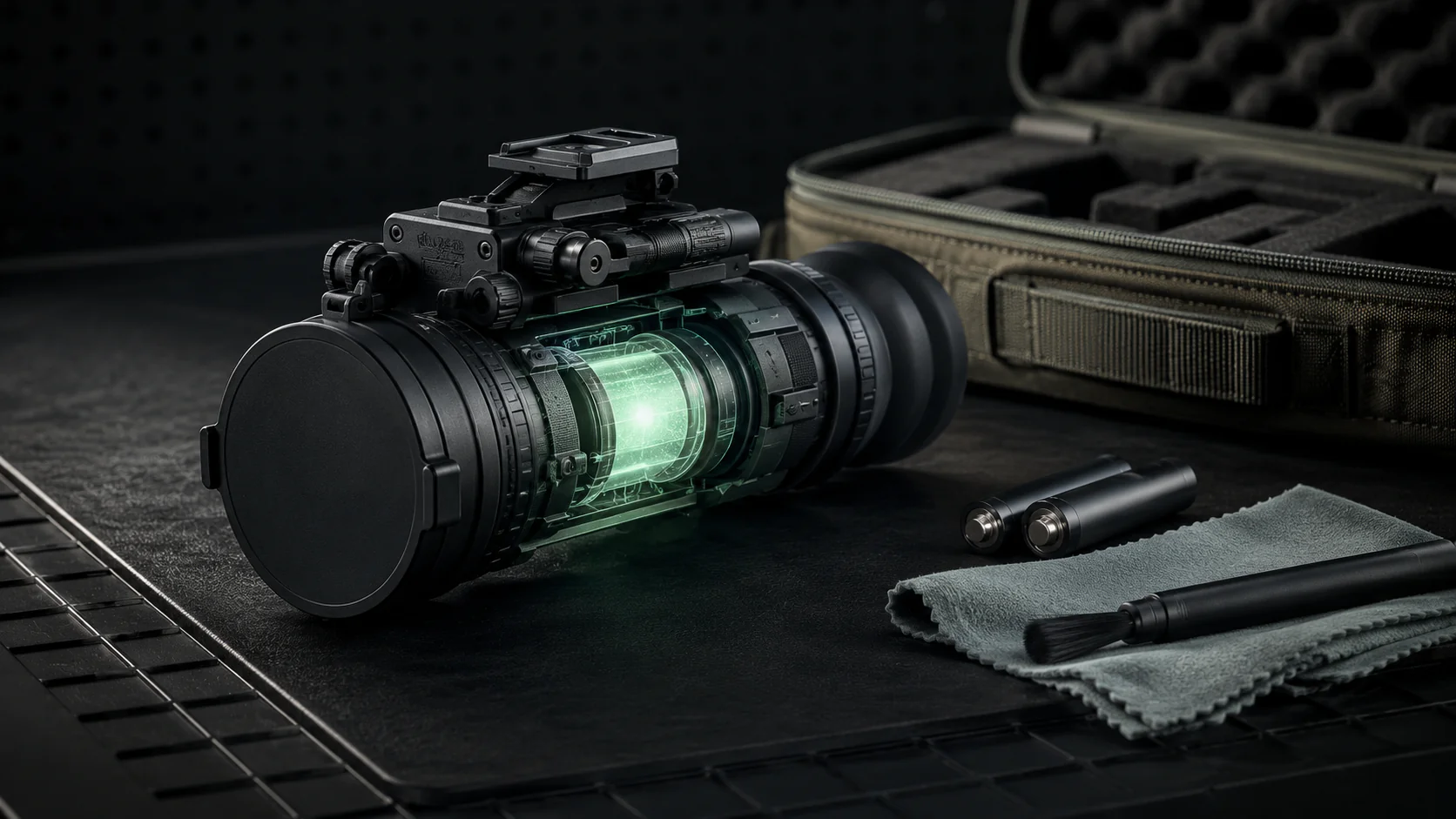
A PVS-14 may look simple from the outside, but inside it is very different from a cheap digital night vision device.
A common PVS-14 monocular includes these main parts:
| Part | What It Does |
|---|---|
| Objective lens | Collects light from the scene |
| Image intensifier tube | Enhances weak light |
| Eyepiece | Lets the user see the image clearly |
| Battery housing | Holds the battery |
| Control knob | Turns the device on/off and controls basic functions |
| Mounting interface | Allows use with helmet mounts or other accessories |
The key part is the image intensifier tube.
This is what makes a real PVS-14 different from many low-cost “night vision style” products.
The basic working process is simple:
Weak light enters the lens → the image intensifier tube makes it brighter → the user sees the image through the eyepiece.
A digital night vision device often works in another way. It may use a camera sensor, a small screen, and an infrared light. That can be useful for simple viewing, but it is not the same type of product.
So when we talk about a real PVS-14, we are not just talking about the shell shape. We are talking about a full optical night vision system.
The outside may look small. The inside is where the real work happens.
3. What Makes PVS-14 Good Value for Beginners?
Good value does not always mean the lowest price.
This is very important.
A cheap night vision product may look attractive at first. The price is low. The shape may look cool. The product pictures may even look professional.
But after real use, buyers may start to notice problems:
- Image is not clear enough
- It needs strong IR light all the time
- The screen has delay
- The housing feels weak
- Accessories do not fit well
- The customer cannot use it for long-term needs
A PVS-14 is usually not the cheapest choice, but it gives better long-term value.
Why?
First, it has a mature structure. Many parts and accessories are made around this type of device. This makes it easier for buyers to build a complete night vision setup.
Second, it is flexible. One device can be used by hand, on a helmet, or with a mount. For new users, this makes it easier to start simple and upgrade later.
Third, it is easier to sell. For B2B customers, this point matters a lot. A product with strong market recognition is easier to explain to end users.
Fourth, a real PVS-14 can be offered with different tube options, such as different FOM levels or green/white phosphor options. This helps dealers build different price levels for different markets.
So the value of PVS-14 is not only in the device itself. It is also in the product ecosystem around it.
In simple words:
PVS-14 is not a one-time toy. It is a product line you can build on.
4. Real PVS-14 vs Cheap Toy-Style Night Vision Devices
This is where many buyers get confused.
Some products look like a PVS-14 from the outside. They may have a similar shape, similar color, and similar product photos.
But when you look closer, they are not the same thing.
Here is a simple comparison:
| Point | Real PVS-14 | Cheap Toy-Style Night Vision Device |
|---|---|---|
| Imaging system | Uses an image intensifier tube | Often uses camera + screen |
| Low-light performance | Works with weak natural light | Often needs IR light |
| Viewing experience | More natural, low delay | May have screen delay |
| Housing | Built for real mounting and use | May only copy the look |
| Accessories | Better helmet/mount compatibility | Often limited compatibility |
| Product life | Better for long-term use | More suitable for simple short-term use |
| Customer type | Serious outdoor, security, dealer, B2B buyer | Low-budget casual user |
This does not mean all cheap digital devices are useless.
They can be fine for basic night viewing, backyard observation, or low-cost product lines. But they should not be sold as the same thing as a real PVS-14 image intensifier monocular.
That is where problems begin.
A toy-style device may look like night vision, but real users will quickly notice the difference in dark areas, fast movement, and long use.
One simple way to explain it:
A cheap digital device helps you “see something” in the dark.
A real PVS-14 helps you “move and observe” in low light more naturally.
That is a big difference.
For dealers, this also affects customer trust. If the product looks professional but performs like a toy, customers may not come back.
Pretty shell, poor image? That is not a good love story.
5. How to Review a PVS-14 Before Buying
A good PVS-14 review should not only say, “The image looks nice.”
That is too simple.
Before buying a PVS-14, especially for wholesale or dealer orders, buyers should check several key points.
1. Check if it uses a real image intensifier tube
This is the first and most important step.
Ask clearly:
- Is it analog image intensifier night vision?
- What tube type is inside?
- Is there a tube spec sheet?
- Are the tube parameters clear?
If the seller only talks about “HD screen” or “digital night vision,” then it is probably not a real PVS-14 image intensifier monocular.
2. Check the tube parameters
Common tube parameters include:
| Parameter | Why It Matters |
|---|---|
| FOM | Shows general tube performance level |
| SNR | Affects image noise and detail |
| Resolution | Affects image sharpness |
| EBI | Affects low-light background quality |
| Halo | Affects strong light performance |
You do not need to become a lab engineer. But these numbers should at least be clear and traceable.
If the seller cannot explain the tube specs, be careful.
3. Check real testing images or videos
Product render images are not enough.
Buyers should ask for real image samples, such as:
- Indoor low-light test
- Outdoor dark area test
- White wall test
- Edge clarity test
- IR on/off comparison if needed
A real review should show what the device can actually see, not only how cool it looks on a black background.
4. Check image quality details
When reviewing the image, do not only look at brightness.
Also check:
- Is the image too noisy?
- Are there clear black spots?
- Is the edge blurry?
- Is there heavy distortion?
- Is there strong halo around lights?
- Can you still see useful details in darker areas?
A super bright image is not always a good image. Sometimes it is just overexposed.
Good night vision should help you see details, not just turn everything into a glowing green or white soup.
5. Check housing and lens quality
The housing and lens also matter.
A good tube inside a poor housing is still a problem.
Check:
- Is the battery housing solid?
- Does the control knob feel stable?
- Is the lens clear?
- Is the focus smooth?
- Does the eyepiece feel comfortable?
- Does the device fit common mounts or accessories?
For B2B buyers, these details affect return rate, customer feedback, and repeat orders.
The tube is the heart, but the housing is the body. You need both to work well.
6. Who Should Choose a PVS-14 Monocular?
A PVS-14 is not for everyone.
And that is fine.
If a customer only wants a very cheap device for simple night viewing, a digital night vision product may be enough.
But if the buyer wants a real starter NVG with better long-term value, PVS-14 is still a strong choice.
PVS-14 is suitable for:
| Buyer Type | Why It Fits |
|---|---|
| Night vision beginners | Easy to understand and widely used |
| Outdoor users | Good for basic night observation |
| Security and patrol customers | Practical for low-light checking |
| Dealers and wholesalers | Easy to explain and build a product line |
| Training/demo users | Mature structure and accessory support |
| Buyers testing the NVG market | Lower entry barrier than dual-tube systems |
For B2B customers, PVS-14 can also be a good starting product before expanding into binocular night vision goggles, panoramic night vision goggles, or thermal clip-on systems.
It helps customers enter the night vision market step by step.
Start with PVS-14. Learn the market. Then upgrade the product line.
Simple, safe, and not too scary.
7. Final Verdict: Is PVS-14 Still Worth It?
Yes, the PVS-14 is still worth considering as a starter NVG.
But here is the honest answer:
It is not the cheapest night vision device.
It is not the most advanced night vision device.
It is not the flashiest product on the shelf.
But it is still one of the most practical choices for buyers who want to enter real image intensifier night vision.
The reason is simple.
PVS-14 has a mature design, strong accessory support, flexible use, and clear market recognition. It gives beginners a real night vision experience without jumping directly into a more expensive dual-tube system.
For dealers and wholesalers, it is also easier to sell because many customers already know what a PVS-14 is.
So, is PVS-14 still the best starter NVG?
For many buyers, yes.
Not because it is perfect.
But because it is practical, trusted, and easy to build a product line around.
And in the night vision business, practical is a very beautiful word.
Conclusion
A real PVS-14 is very different from a cheap toy-style night vision device.
The value is not only in the shell. It is in the image intensifier tube, the optical system, the structure, the accessories, and the real user experience.
For buyers who only need simple night viewing, a low-cost digital device may be enough. But for customers who want to enter the real night vision market, PVS-14 is still a smart starting point.
Before buying, do not only look at product photos. Check the tube, image quality, housing, lens, accessories, and real test images.
A good PVS-14 should not just look like night vision.
It should actually perform like one.