
How to Choose the Right Image Intensifier Tube
for Your Night Vision Needs
Selecting the right IIT is crucial for night vision performance. Learn how to assess your needs, pick the right FOM, phosphor type, and tube setup, and avoid common buyer mistakes.
1. First Identify Your Needs Before Choosing an IIT
Before selecting a transistor, clearly defining your usage requirements is the most crucial step. Different applications and customer types have vastly different requirements for performance, price, and configuration. Without clearly defining your needs first, it’s easy to end up with a mismatched selection or wasted costs.
1.1 Personal Use vs Resale
For personal use: Hunters, outdoor adventurers, or professional observers prioritize cost-effectiveness, night vision clarity, and after-sales service.
Wholesale distributors: Need to consider equipment compatibility, batch stability, and overall cost versus profit.
Brand owners: Focus more on product performance and brand image. They typically prefer high FOM (Form of Image) and high-performance products.
1.2 Required Night Vision Performance
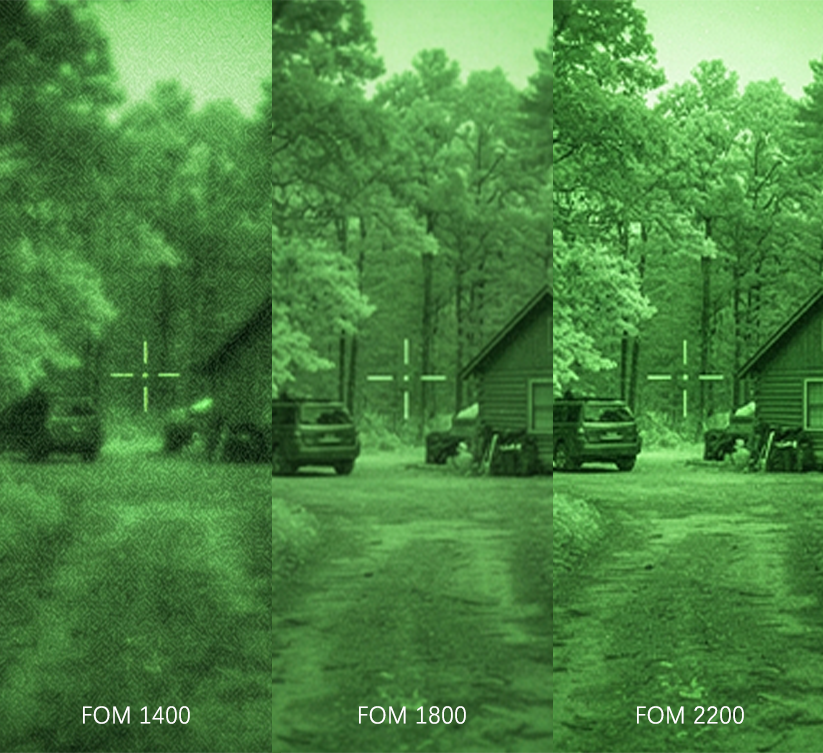
FOM <1200:
This type of IIT works best in places with one light source and a short target distance. It suits patrols in urban buildings or warehouses. Precision is not the primary concern; the key is the ability to identify moving objects in low-light conditions.
FOM 1200–1800:
Suitable for patrols in woodlands, outdoor use, hunting, or remote areas. Allows clear viewing of people, animals, and nearby details in starlight or low light.
FOM >1800:
Designed for deep mountains or very low-light settings, such as science research, military use, and special reconnaissance. It keeps high contrast and clear, low-noise images, even at long range or in low light.
2. Understanding the Key Differences Between Image Intensifier Tubes
Image intensifier tubes (IITs) are core components of night vision equipment, and their manufacturing process is extremely complex. Manufacturing IITs involves multiple precision technologies, including high-vacuum environments, microchannel plate amplification, and phosphorescent screen deposition. Due to these technological barriers, only a few manufacturers worldwide are capable of producing stable and high-performance IITs.
Even tubes from the same company can perform differently due to material differences, manufacturing tolerances, and grading. Therefore, people typically classify and select IITs based on several key parameters.
The following are the most important factors for distinguishing image intensifier tubes.
2.1 FOM (Figure of Merit)
FOM is one of the most widely used metrics for evaluating the performance of an image intensifier tube. Multiply the resolution by the signal-to-noise ratio (SNR) to calculate it. Together, they determine how clearly a device displays images in low light.
In general, the higher the FOM value, the better the image quality and low-light capability.
I introduced the selection scenarios for different FOMs above, so I will not repeat them here.
It is important to note that higher FOM values typically mean higher costs. Therefore, selecting the appropriate FOM level depends on the intended application and budget.
2.4 Gain Control and Gating Technology
Gain refers to the level of signal amplification within the image intensifier tube.
Manual Gain Control
- Allows users to manually adjust image brightness
- Useful when operating in environments with changing light conditions
Fixed Gain
- Gain level is preset during manufacturing
- Simpler design and often lower cost
Another key technology is auto-gating.
Auto-Gated Tubes
- Automatically adjust the electron flow when exposed to sudden bright light
- Protect the tube from damage
- Maintain image clarity in dynamic lighting environments
- The disadvantage is that the image continuity is not as good as that of non-gated tubes.
Non-Gated Tubes
- Simpler internal structure/Lower cost/Good image continuity, stable imaging, and no screen flicker.
- But less adaptable to rapidly changing light conditions. Strong light maybe damages it.
People commonly prefer auto-gating for higher-end night vision systems.
2.2 Phosphor Screen Type (Green vs White)
Another major difference between IITs is the type of phosphor screen used to convert amplified electrons into visible images.
Night vision devices widely use two common phosphor types.
Green Phosphor (P43)
Green phosphor has been the traditional standard for decades. It delivers stable performance, and many night vision systems use it.
Advantages:
- Mature technology with stable production
- Generally lower cost
- Widely compatible with many devices
White Phosphor (P45)
White phosphor tubes create a grayscale image that many users find more natural and easier to read.
Advantages:
- More natural image perception
- Improved contrast for some users
- Increasingly popular in modern night vision systems
The choice between green and white phosphor often depends on user preference, device positioning, and target market.
2.5 Image Intensifier Tube Structure and Output Interface
Image intensifier tubes may differ in their physical interfaces and connection methods.
Common structural types include:
- 2 or 3 contact type
- 2 or 3 leaded type
- pigtail type, etc.
These design differences decide how the image intensifier tube connects to the power supply, controls, and optics.
Choosing the correct interface is crucial for compatibility with the intended night vision equipment.
2.3 Input Window Structure
The input window is the front surface of the image intensifier tube. Incoming photons first interact with the photocathode there. Its structure can influence optical compatibility and overall system design.
Common input window structures include:
Concave Window
Often used in certain optical designs where curvature helps optimize image transmission.
Convex Window
Provides alternative optical matching depending on the device configuration.
Flat Window
A simpler structure that is compatible with many standard optical systems.
Design requirements for the night vision device determine the selection of different input window shapes.
2.6 Tube Diameter and Power Configuration
The most common tube diameter used in many night vision systems is approximately:
Φ36.7 × 30.4 mm
However, depending on the design of the night vision equipment, other tube diameters and larger formats exist.
Larger tubes may offer different optical characteristics, while smaller tubes may be more suitable for lightweight systems. You need to select the appropriate IIT based on the size of your equipment.
Some image intensifier tubes also differ in their internal power supply configuration.
For example, certain designs use front-mounted power structures, where the photocathode input window incorporates a colored grid structure.
This configuration can influence:
- electrical integration
- optical compatibility
- overall device design
Different power configurations are typically selected based on the engineering requirements of the night vision system.
3.Practical Buying Guide for Different Applications
After understanding the technical differences between image intensifier tubes, the next step is determining which configuration best matches your application, budget, and market positioning.
Different buyers evaluate IIT tubes from different perspectives.
End users often focus on performance and use cases. Distributors and brands pay more attention to pricing strategy and product positioning.
The following guide explains how to choose suitable IIT configurations from both perspectives.
3.1 Choosing IIT for End-User Applications
For individual users, the most important factors are actual usage scenarios and budget.
In most consumer markets, people mainly use night vision devices for hunting or tactical/professional outdoor activities.
Different usage environments usually correspond to different performance levels and price ranges.
Mid-Range Tubes (USD 800–1200)
These tubes offer balanced performance and cost, making them suitable for most hunting and outdoor observation applications. They provide stable image clarity under moonlight or starlight conditions, and consumers use them widely in night vision devices.
High-Performance Tubes (USD 1200–2000)
Engineers design high-end tubes for more demanding environments with extremely low light conditions. They usually offer better image contrast, lower noise levels, and improved long-distance observation capabilities.
For most civilian markets, mid-range tubes meet the needs of most users. Professionals or enthusiasts who want top performance usually choose high-end tubes.
3.2 Choosing IIT for Different Business Strategies
Low-Budget Distributors
Expanding Product Range
Mid-Budget Distributors
Target Profitable Products
Premium Brands
Targeting High Markets
Choosing the right image intensifier tube depends on the end user. It also depends on the buyer’s market strategy.
- Individual users usually choose tubes based on performance and price.
- Distributors and brands typically select tubes based on market positioning and profit strategy.
Understanding these factors helps you build night vision products that work well. It also helps you stay competitive in the market.
If you’re not sure which IIT configuration fits your market, our engineers can help you select the right tube.
5 Mistakes Buyers Make When Choosing an IIT
Mistake 1: Not Defining the Target Market
Some buyers choose tubes without defining their target users, such as beginners, hunters, or professionals.
Mistake 2: Ignoring Budget-to-Performance Balance
Higher specifications usually mean higher cost. Choosing overly expensive tubes may reduce product competitiveness in price-sensitive markets.
Mistake 3: Overlooking Market Demand
In many commercial markets, mid-range performance tubes sell significantly better than extremely high-end options.
Mistake 4: Lack of Long-Term Supply Consideration
Stable supply and consistent quality are critical when building a long-term product line.
Mistake 5: Not Consulting Technical Experts
Because IIT technology is complex, working with experienced suppliers can help buyers avoid compatibility issues and improve device performance.
Market Outlook for Image Intensifier Tubes
Despite advances in digital night vision and thermal imaging, image intensifier tubes are still important. Many night vision systems still use them.
Several trends are expected to shape the IIT market in the coming years:
1.Continued Demand in Civilian Outdoor Markets
Hunting, wildlife watching, and outdoor exploration keep demand high for night vision devices. This is especially true in North America and Europe.
2.Increasing Availability of High-Performance Tubes
Advancements in manufacturing technology are gradually making higher-performance tubes more accessible to commercial markets.
3.Product Differentiation Through Image Quality
Manufacturers and brands are placing greater emphasis on image clarity, viewing comfort, and overall user experience.
4.Growing Opportunities for System Integrators and Brands
As the global night vision industry grows, more companies are joining the market as manufacturers, distributors, and system integrators.
Final Thoughts
Image intensifier tubes remain the core component of traditional night vision systems.
For buyers, understanding how to match IIT performance with real-world applications and market demand is essential.