Date
Introduction
Night vision goggles may look like “magic” when you first turn them on. A dark road, a shadowed field, or a room with almost no visible light suddenly becomes clear enough to walk through.
But night vision is not magic. It is optical and electronic technology working together.
What Is BNVD 1431?
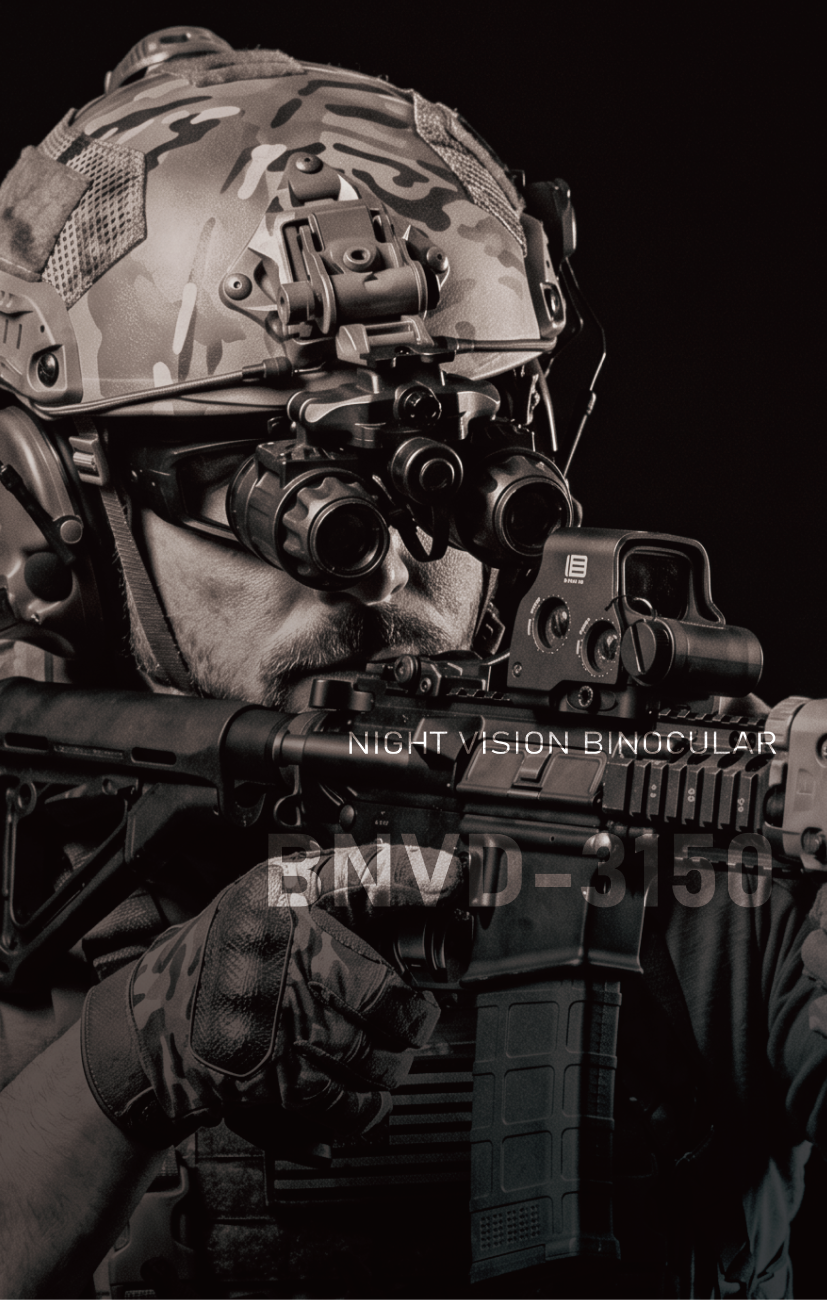
The BNVD 1431 is a binocular night vision goggle designed for low-light observation. Unlike a digital night vision device that uses a camera and screen, this type of night vision uses an image intensifier tube to amplify available light.
Based on the product information, this model supports GEN2+ / GEN3 image intensifier tubes, with FOM options from FOM1400 to FOM2400 or above. It also uses a PVS-14 style eyepiece and objective lens assembly, which makes it compatible with Carson’s PVS-14 and RPO3.0 lens assemblies.
Basic product specifications include:
| Specification | BNVD 1431 |
|---|---|
| Type | Night Vision Binocular |
| Magnification | 1X |
| Field of View | 40° |
| Focus Range | 25 cm to infinity |
| Objective Lens | 27 mm / F1.2 |
| Diopter Adjustment | -6D to +2D |
| Eye Relief | 25 mm |
| Power Source | 1 × AA / 1 × 5-HRS |
| Weight | 535 g without battery |
| Dimensions | 110 × 115 × 100 mm |
How Does This Type of Night Vision Work?
The working process is easier to understand if we break it into four steps.
First, a tiny amount of light enters the objective lens. This light may come from the moon, stars, distant buildings, or other weak light sources in the environment.
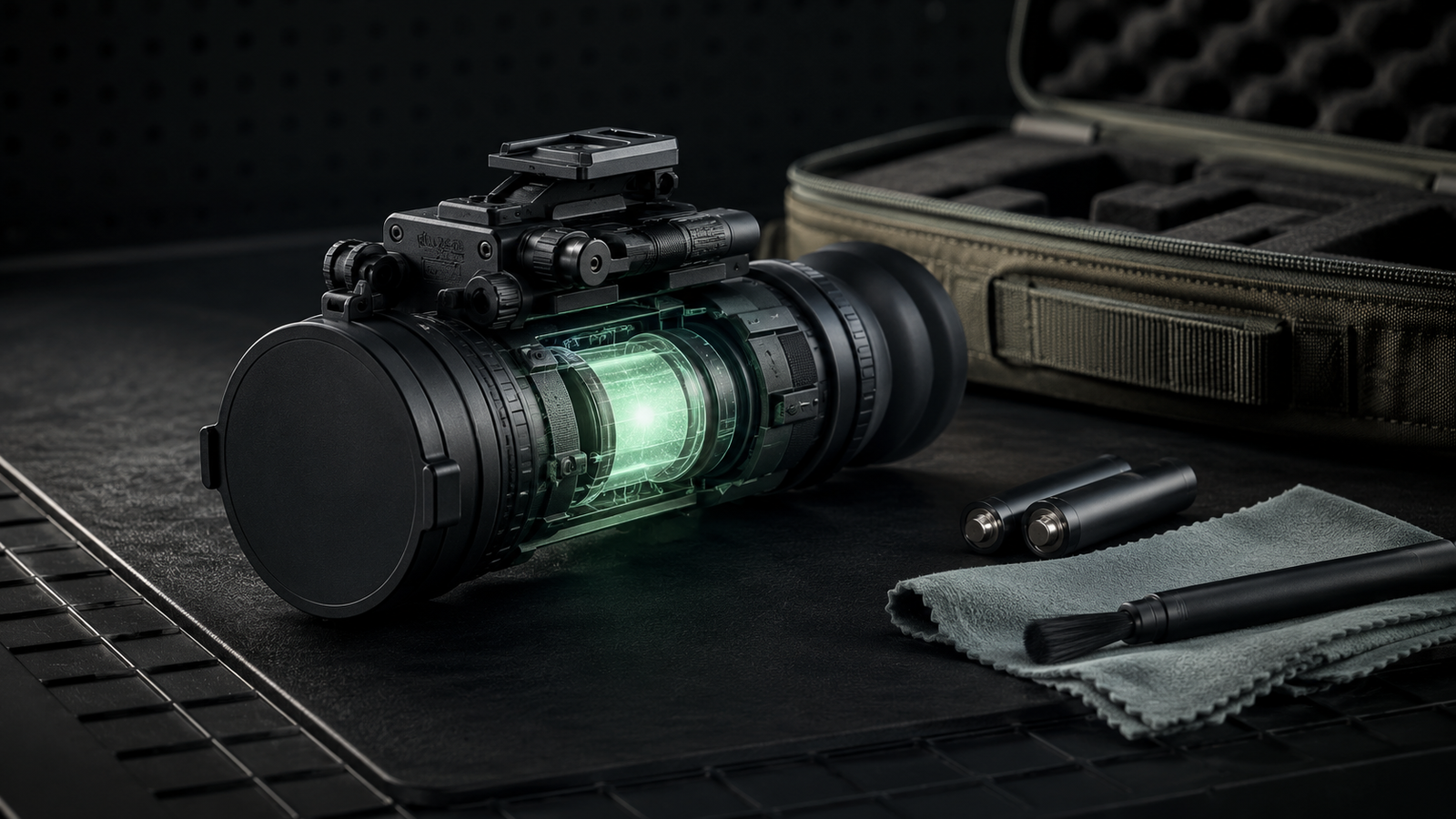
Second, the objective lens focuses that light into the image intensifier tube. Inside the tube, photons hit the photocathode and are converted into electrons.
Third, these electrons are multiplied inside the tube. This is the key reason why a very dark scene can become much brighter.
Finally, the electrons hit a phosphor screen and are converted back into visible light. The user then sees the amplified image through the eyepiece.
In simple words:
The device does not create a scene from nothing. It collects weak light, amplifies it, and sends a brighter image to your eyes.
Test Scene 1: Outdoor Low-Light Observation
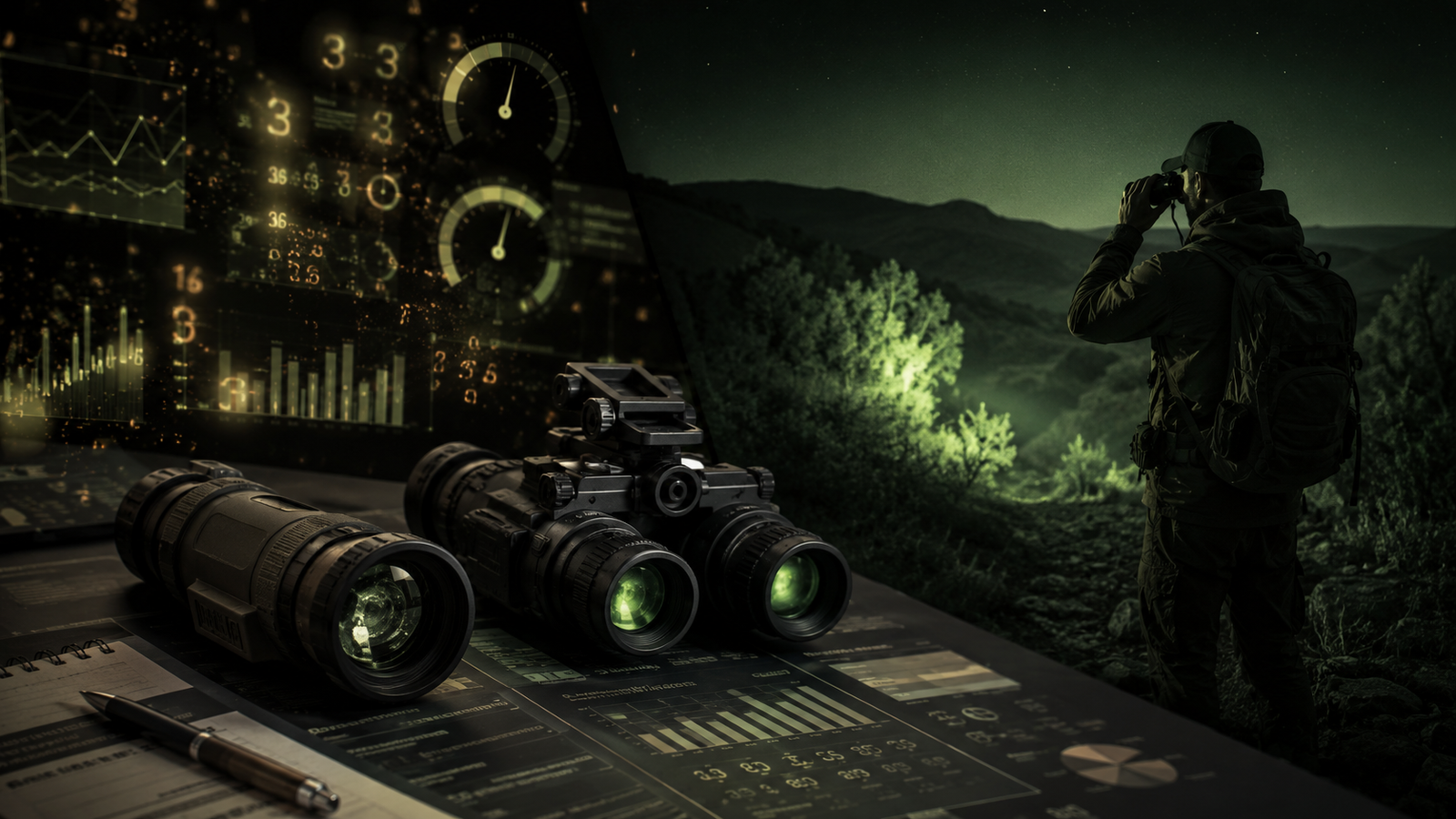
In a normal outdoor low-light environment, such as a field or road under moonlight or starlight, the BNVD 1431 can make the scene much easier to recognize.
Because it is a 1X binocular night vision device, the image keeps a natural viewing scale. The user can observe the environment without the “zoomed-in” feeling of a scope. This is important for walking, scanning, and general movement.
The 40° field of view is a common field of view for many traditional night vision goggles. It is not as wide as human natural vision, so users still need to move their head to scan the surroundings. However, compared with monocular viewing, binocular night vision gives a more comfortable and natural observation experience.
Test Scene 2: Close Focus and Equipment Check
One useful detail of the BNVD 1431 is its 25 cm to infinity focus range.
This means the user can focus not only on distant objects, but also on closer items such as maps, gear, tools, or equipment panels. For practical night observation, close focus is often overlooked, but it can make a big difference.
For example, when checking a device, adjusting gear, or reading a nearby object in low light, a short focus distance helps the user stay aware without removing the goggles.
Test Scene 3: Why Lens Quality Matters
Night vision performance is not only about the image intensifier tube. The lens assembly also matters.
The BNVD 1431 uses a PVS-14 style eyepiece and objective lens structure. According to the product information, it is compatible with Carson’s PVS-14 and RPO3.0 lens assemblies.
A better optical system can help improve:
| Optical Factor | Why It Matters |
| Edge clarity | Helps keep the image cleaner near the sides |
| Light transmission | Allows more useful light to enter the tube |
| Image sharpness | Makes small details easier to recognize |
| Eye comfort | Reduces viewing fatigue during longer use |
For B2B buyers, this is an important point. Two night vision devices with similar tube specifications may still perform differently if the lenses, alignment, and assembly quality are different.
What Happens in Complete Darkness?
Image intensifier night vision needs some light to work. If the environment has almost no available light, the image may become noisy, unclear, or filled with grain.
This does not mean the device is broken. It is a normal limitation of image intensifier technology.
In very dark indoor rooms, underground spaces, or sealed environments, users may need an IR illuminator. An IR illuminator provides invisible infrared light that the night vision device can detect. To the naked eye, the area still looks dark, but through night vision, it becomes visible.
So the rule is simple:
Image intensifier night vision amplifies existing light. If there is not enough light, IR illumination may be needed.
White Phosphor, Green Phosphor, and Tube Choice
The final image color depends on the phosphor screen and tube configuration. Many modern users prefer white phosphor because it can feel more natural and may make details easier to distinguish for long observation.
For the BNVD 1431, tube options can support different performance levels, such as GEN2+ / GEN3 and FOM1400–FOM2400 or above.
FOM is a useful reference, but it should not be the only thing buyers check. A complete evaluation should also consider:
| Parameter | Why Buyers Should Check It |
| FOM | General tube performance reference |
| Resolution | Detail recognition ability |
| SNR | Image cleanliness in low light |
| Gain | Brightness amplification ability |
| Spots / blemishes | Visual quality of the tube |
| Lens quality | Sharpness and light transmission |
| Assembly quality | Alignment, comfort, and reliability |
Practical Advantages of BNVD 1431
For users who want a binocular night vision platform, BNVD 1431 offers several practical advantages.
It uses a familiar binocular layout, supports manual adjustment, and has a compact structure. The 535 g weight without battery makes it lighter than many heavy-duty multi-tube systems, while still giving the user binocular observation.
The 1X magnification is also useful because it keeps the image close to natural vision. This makes it more suitable for walking, general observation, and equipment operation compared with high-magnification night vision scopes.
For distributors and wholesale buyers, the key value is not only the device itself, but also the flexibility of tube selection, lens compatibility, and product configuration.
Conclusion
The BNVD 1431 is a good example of how modern image intensifier night vision works. It collects weak ambient light, amplifies it through the image intensifier tube, and presents a brighter image through the eyepiece.
It is not a digital camera, and it is not thermal imaging. It is a real-time optical-electronic system designed for natural low-light observation.
For buyers comparing night vision binoculars, the most important point is not to look at one specification alone. Field of view, tube grade, lens quality, focus range, weight, and assembly quality all affect the real viewing experience.
If you are choosing binocular night vision goggles for wholesale, distribution, or professional outdoor applications, BNVD 1431 is worth considering as a flexible platform with GEN2+ / GEN3 tube options and PVS-14 style optical compatibility.