
- by qcuenv@gmail.com
- published
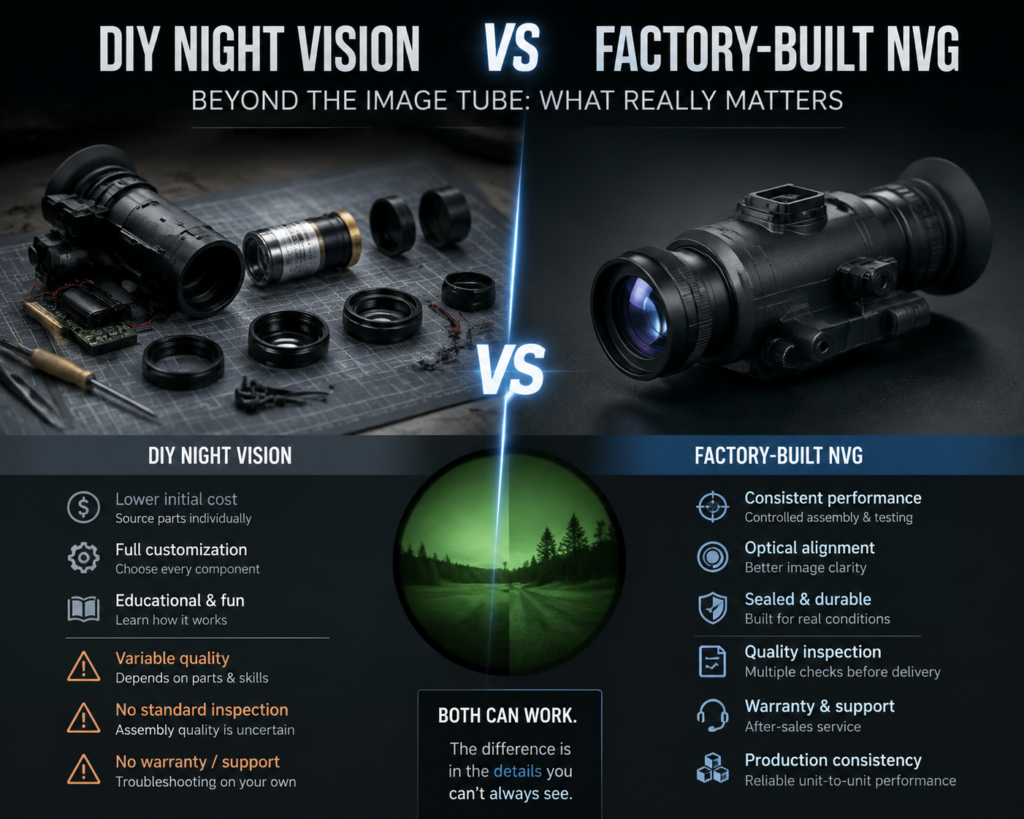
DIY Night Vision vs Factory-Built NVG: What Are You Really Paying For?
A working night vision monocular can sometimes be built for far less than the price of a complete commercial unit.
That sounds like proof that factory-built night vision goggles are overpriced.
But is it really that simple?
A DIY night vision device and a factory-built NVG may use similar-looking components: an image intensifier tube, an objective lens, an eyepiece, a housing and a power supply. Once both devices turn on and produce a visible image, it is easy to assume that they are basically the same.
They are not.
The real difference is not whether the device can produce an image. The difference is how consistently, reliably and safely it performs after hours of use, repeated movement and changing environmental conditions.
Why DIY Night Vision Is So Attractive
The appeal of DIY night vision is easy to understand.
Instead of purchasing a complete night vision monocular, the user sources each component separately:
An image intensifier tube
An objective lens
An eyepiece
A housing
A battery compartment
Internal contacts and mounting parts
A second-hand image tube, a surplus lens set or a 3D-printed housing can significantly reduce the total cost.
For technically experienced users, the process is also part of the fun. Building the device provides a better understanding of how night vision works and allows the user to select each component individually.
And in some cases, the finished unit really does work.
It can turn on. It can amplify available light. It can produce a usable image in a dark environment.
But “it works” is only the first level of evaluation.
The Image Tube Is Not the Entire NVG
The image intensifier tube is normally the most valuable component inside an analog night vision device.
However, placing a good tube inside a housing does not automatically create a good night vision system.
The final image also depends on:
Lens quality
Optical alignment
Tube compatibility
Electrical stability
Internal cleanliness
Focus adjustment
Housing precision
Mechanical assembly
A high-performance tube combined with poor optics may produce edge distortion, reduced clarity or an inconsistent field of view.
A properly functioning tube installed in a poorly sealed housing may later suffer from dust, moisture or internal contamination.
This is why comparing NVGs only by tube generation or FOM can be misleading. The image tube is the heart of the device, but the surrounding system determines how well that heart performs.
What DIY Builds Usually Do Not Include
A DIY project normally focuses on one result:
Can the device be assembled and used?
A factory-built NVG must answer several additional questions:
Is the optical path properly aligned?
Is the image clear across the usable field of view?
Are the lenses and tube correctly matched?
Is the power supply stable?
Are the internal contacts secure?
Is the housing sealed correctly?
Does the device remain stable after repeated operation?
Can another unit be produced with similar performance?
These differences are not always visible during a short night test.
A DIY unit may look impressive during the first few minutes of use. Long-term issues often appear later: inconsistent power contact, loose focus components, internal dust, moisture exposure or gradual mechanical wear.
Factory assembly is intended to reduce these uncertainties before the product reaches the user.
Assembly Quality Is Difficult to See in a Specification Sheet
Two night vision monoculars may list similar specifications and still perform very differently.
One of the reasons is assembly tolerance.
Inside a night vision device, small deviations can affect the final viewing experience. The distance between the tube and optical components, the position of the tube, the precision of the threads and the stability of the electrical contacts all matter.
A complete factory-built NVG should involve more than simply installing the parts.
Typical production work may include:
Inspecting the image intensifier tube
Checking the lens components
Cleaning the internal optical area
Installing and positioning the tube
Testing the power system
Adjusting the focus range
Checking the visible image
Completing final functional inspection
The exact inspection process varies between manufacturers, but the principle remains the same: repeatability is part of the product.
A DIY builder only needs to make one unit work.
A manufacturer needs to make multiple units perform consistently.
The Real Test Is Not Just Turning It On
Many DIY demonstrations end with a night scene showing that the device produces a visible image.
That is an important test, but it is not a complete evaluation.
A more useful comparison between DIY and factory-built night vision should include:
| Test | What It Reveals |
|---|---|
| Low-light image test | Basic image amplification performance |
| Edge clarity check | Optical quality across the field of view |
| Focus range test | Near and distant focusing capability |
| Extended operation | Power and electrical stability |
| Movement test | Mechanical security and contact reliability |
| Internal inspection | Dust, debris and assembly cleanliness |
| Repeated power cycling | Reliability of switches and electrical contacts |
| Unit-to-unit comparison | Manufacturing consistency |
A single successful image does not prove that the system is durable.
In the same way, a higher price does not automatically prove that a factory-built unit is better. The value must come from traceable components, proper assembly, inspection and after-sales support.
When Does a DIY NVG Make Sense?
DIY night vision can be a reasonable option for users who:
Understand night vision components
Can verify the condition of the image tube
Have experience with optical and electrical assembly
Accept the possibility of troubleshooting
Do not require consistent production quality
Are comfortable without standard commercial support
For these users, DIY night vision can be an educational and cost-effective project.
However, the lowest initial cost does not always become the lowest final cost.
A damaged tube, incompatible lens set, unstable power component or poorly manufactured housing can quickly turn a budget build into an expensive experiment.
When Is a Factory-Built NVG the Better Choice?
A factory-built NVG is usually more suitable for distributors, outdoor equipment companies, professional users and customers who need predictable performance.
These buyers are not only paying for the physical components.
They are also paying for:
Component selection
Assembly experience
Optical matching
Functional inspection
Production consistency
Warranty support
Replacement and repair channels
For B2B buyers, consistency is especially important.
A distributor cannot rely on one sample performing well. Every delivered unit must remain within an acceptable quality range. The product must also have clear specifications, repeatable configuration and a supplier capable of handling technical or after-sales issues.
That is where factory-built products create value beyond the bill of materials.
DIY Night Vision Is Not the Enemy of Factory-Built NVGs
DIY night vision videos are useful because they reveal an important truth: an analog night vision device is not a mysterious sealed box.
It is a system made from identifiable components.
But they also reveal another truth.
Building a device that produces an image is much easier than building a device that produces a reliable image repeatedly.
DIY night vision proves what is technically possible.
Factory-built night vision should prove what is consistently deliverable.
The better question is therefore not:
“Why does a factory-built NVG cost more than a DIY unit?”
The better question is:
“What testing, assembly quality, component traceability and support are included in that price?”
If a supplier cannot answer that question, the higher price may not be justified.
But when those processes are real, documented and repeatable, the buyer is not simply paying for an image tube inside a housing.
The buyer is paying for a complete night vision system.
- by qcuenv@gmail.com
- published
DIY Night Vision vs Factory-Built NVG: What Are You Really Paying For?
A working night vision monocular can sometimes be built for far less than the price of a complete commercial unit.
That sounds like proof that factory-built night vision goggles are overpriced.
But is it really that simple?
A DIY night vision device and a factory-built NVG may use similar-looking components: an image intensifier tube, an objective lens, an eyepiece, a housing and a power supply. Once both devices turn on and produce a visible image, it is easy to assume that they are basically the same.
They are not.
The real difference is not whether the device can produce an image. The difference is how consistently, reliably and safely it performs after hours of use, repeated movement and changing environmental conditions.
Why DIY Night Vision Is So Attractive
The appeal of DIY night vision is easy to understand.
Instead of purchasing a complete night vision monocular, the user sources each component separately:
An image intensifier tube
An objective lens
An eyepiece
A housing
A battery compartment
Internal contacts and mounting parts
A second-hand image tube, a surplus lens set or a 3D-printed housing can significantly reduce the total cost.
For technically experienced users, the process is also part of the fun. Building the device provides a better understanding of how night vision works and allows the user to select each component individually.
And in some cases, the finished unit really does work.
It can turn on. It can amplify available light. It can produce a usable image in a dark environment.
But “it works” is only the first level of evaluation.
The Image Tube Is Not the Entire NVG
The image intensifier tube is normally the most valuable component inside an analog night vision device.
However, placing a good tube inside a housing does not automatically create a good night vision system.
The final image also depends on:
Lens quality
Optical alignment
Tube compatibility
Electrical stability
Internal cleanliness
Focus adjustment
Housing precision
Mechanical assembly
A high-performance tube combined with poor optics may produce edge distortion, reduced clarity or an inconsistent field of view.
A properly functioning tube installed in a poorly sealed housing may later suffer from dust, moisture or internal contamination.
This is why comparing NVGs only by tube generation or FOM can be misleading. The image tube is the heart of the device, but the surrounding system determines how well that heart performs.
What DIY Builds Usually Do Not Include
A DIY project normally focuses on one result:
Can the device be assembled and used?
A factory-built NVG must answer several additional questions:
Is the optical path properly aligned?
Is the image clear across the usable field of view?
Are the lenses and tube correctly matched?
Is the power supply stable?
Are the internal contacts secure?
Is the housing sealed correctly?
Does the device remain stable after repeated operation?
Can another unit be produced with similar performance?
These differences are not always visible during a short night test.
A DIY unit may look impressive during the first few minutes of use. Long-term issues often appear later: inconsistent power contact, loose focus components, internal dust, moisture exposure or gradual mechanical wear.
Factory assembly is intended to reduce these uncertainties before the product reaches the user.
Assembly Quality Is Difficult to See in a Specification Sheet
Two night vision monoculars may list similar specifications and still perform very differently.
One of the reasons is assembly tolerance.
Inside a night vision device, small deviations can affect the final viewing experience. The distance between the tube and optical components, the position of the tube, the precision of the threads and the stability of the electrical contacts all matter.
A complete factory-built NVG should involve more than simply installing the parts.
Typical production work may include:
Inspecting the image intensifier tube
Checking the lens components
Cleaning the internal optical area
Installing and positioning the tube
Testing the power system
Adjusting the focus range
Checking the visible image
Completing final functional inspection
The exact inspection process varies between manufacturers, but the principle remains the same: repeatability is part of the product.
A DIY builder only needs to make one unit work.
A manufacturer needs to make multiple units perform consistently.
The Real Test Is Not Just Turning It On
Many DIY demonstrations end with a night scene showing that the device produces a visible image.
That is an important test, but it is not a complete evaluation.
A more useful comparison between DIY and factory-built night vision should include:
| Test | What It Reveals |
|---|---|
| Low-light image test | Basic image amplification performance |
| Edge clarity check | Optical quality across the field of view |
| Focus range test | Near and distant focusing capability |
| Extended operation | Power and electrical stability |
| Movement test | Mechanical security and contact reliability |
| Internal inspection | Dust, debris and assembly cleanliness |
| Repeated power cycling | Reliability of switches and electrical contacts |
| Unit-to-unit comparison | Manufacturing consistency |
A single successful image does not prove that the system is durable.
In the same way, a higher price does not automatically prove that a factory-built unit is better. The value must come from traceable components, proper assembly, inspection and after-sales support.
When Does a DIY NVG Make Sense?
DIY night vision can be a reasonable option for users who:
Understand night vision components
Can verify the condition of the image tube
Have experience with optical and electrical assembly
Accept the possibility of troubleshooting
Do not require consistent production quality
Are comfortable without standard commercial support
For these users, DIY night vision can be an educational and cost-effective project.
However, the lowest initial cost does not always become the lowest final cost.
A damaged tube, incompatible lens set, unstable power component or poorly manufactured housing can quickly turn a budget build into an expensive experiment.
When Is a Factory-Built NVG the Better Choice?
A factory-built NVG is usually more suitable for distributors, outdoor equipment companies, professional users and customers who need predictable performance.
These buyers are not only paying for the physical components.
They are also paying for:
Component selection
Assembly experience
Optical matching
Functional inspection
Production consistency
Warranty support
Replacement and repair channels
For B2B buyers, consistency is especially important.
A distributor cannot rely on one sample performing well. Every delivered unit must remain within an acceptable quality range. The product must also have clear specifications, repeatable configuration and a supplier capable of handling technical or after-sales issues.
That is where factory-built products create value beyond the bill of materials.
DIY Night Vision Is Not the Enemy of Factory-Built NVGs
DIY night vision videos are useful because they reveal an important truth: an analog night vision device is not a mysterious sealed box.
It is a system made from identifiable components.
But they also reveal another truth.
Building a device that produces an image is much easier than building a device that produces a reliable image repeatedly.
DIY night vision proves what is technically possible.
Factory-built night vision should prove what is consistently deliverable.
The better question is therefore not:
“Why does a factory-built NVG cost more than a DIY unit?”
The better question is:
“What testing, assembly quality, component traceability and support are included in that price?”
If a supplier cannot answer that question, the higher price may not be justified.
But when those processes are real, documented and repeatable, the buyer is not simply paying for an image tube inside a housing.
The buyer is paying for a complete night vision system.
You’ll also like
The Ultimate Guide to Modern Night Vision Devices — QCNV
The Ultimate Guide to Modern Night Vision Devices — QCNV When the sun sets and the world fades into shadows, a reliable night vision device
The reason night vision devices are so expensive
The reason night vision devices are so expensive Table of Contents Chapter 1 Why Image Intensifier Tubes Define the Cost of Night Vision Devices? 1.1 What
You’ll also like
How Night Vision Goggles and Infrared Thermal Devices Work
Night vision goggles and infrared thermal devices use two different methods. They help people see in low-light or no-light situations.
2026 Night Vision Production Plan
Manufacturing Perspective ·IIT Housing Production