Topic | Best For | Main Goal |
Night vision care | New users, dealers, and project buyers | Reduce tube damage and storage-related issues |
Intro: No Fluff, Just Real Care Tips
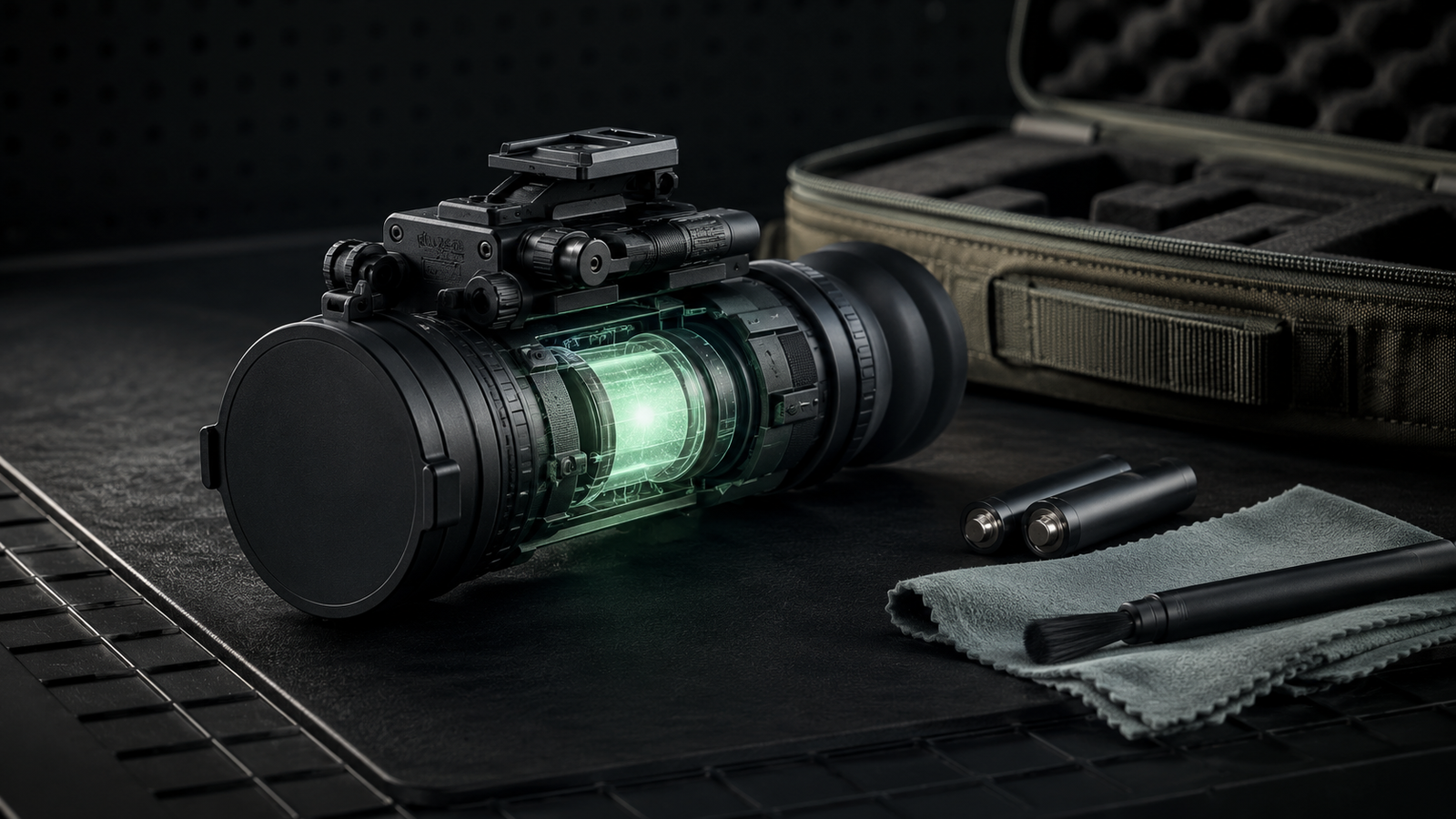
Let’s be real – night vision gear is not cheap. Whether you are using a PVS-14, dual-tube goggles, or a custom-built system, the most expensive part inside is usually the image intensifier tube.
A good tube can last for five, six, or even more years if you treat it right. But one careless mistake can cost you hundreds or even thousands of dollars.
So today, no fluff and no spec-sheet overload. Just the do’s and don’ts of night vision care, explained in a simple way.
Part 1: Don’t Cheap Out on Batteries
First thing first – batteries.
Stay away from no-name batteries. Never use batteries that look swollen, rusty, leaking, or wet. Lithium batteries are usually a safer choice than cheap alkaline batteries because they are less likely to leak.
Whether your device runs on AA, CR123, or another battery type, remember one simple rule:
Don’t mix old and new batteries. Don’t use damaged cells.
Part 2: Take the Batteries Out Before Storage
A lot of people use their night vision, turn it off, and toss it straight into a closet or gear bag with the batteries still inside. That is a small mistake waiting to become an expensive problem.
The risk is not only battery leakage. Accidental power-on is also a problem. You might be cleaning your bag, wiping the unit, or moving gear around, and suddenly press the power button by mistake. If the lens is facing a ceiling light or a bright window, the tube may take unnecessary light exposure.
Build this habit every time:
Power off -> remove the battery -> put the lens cap on -> store it in a protective case.
Do this every time, and you will avoid many common storage-related problems.
Part 3: Will Bright Light Instantly Kill Your Tube?
This is probably the number one question from new users: “If I look at a light, is my tube dead?”
Here is the real answer: a quick glance usually will not kill it. Staring at it might.
Modern image intensifier tubes are tougher than many people think, but they are not invincible. Do not point your device at headlights, streetlights, searchlights, strong flashlights, or even the moon for a long time.
The rule of thumb is simple:
Scan fast. Don’t stare.
Part 4: Temporary Marks Are Not Always Permanent Burns
Sometimes, after your night vision device catches a bright light source, you may see a faint line, shadow, or ghost mark in the image. Don’t panic right away.
In many cases, this is only a temporary ghost image, not permanent tube damage. It may fade after a few seconds or minutes.
But if the mark stays there and does not improve, stop testing it against more light. That is the wrong move. At that point, follow the manual or contact your supplier or manufacturer.
Part 5: The “Black Box” Method – Use It Carefully
Some night vision users talk about the “black box” method. The idea is to cover the objective lens completely and let the unit run in total darkness for a period of time. This may help reduce some temporary image marks.
But this only makes sense if it is done correctly.
Make sure no light can enter the objective lens. Make sure the battery has enough power. If your product manual gives specific instructions, follow the manual first.
If the mark does not improve after that, do not keep trying random methods. Contact your supplier or manufacturer for proper advice.
Part 6: Lasers Are the Hidden Danger
Many people worry about bright lights, but they often forget about lasers.
Infrared lasers are invisible to your eyes, but your night vision device can see them. That energy can still hit the image intensifier tube and may leave damage.
Laser reflections are even easier to miss. Reflections from glass, water, mirrors, vehicles, metal surfaces, or other shiny objects can still bounce back into the tube.
So remember:
Do not point lasers near reflective surfaces. Do not scan areas with active laser use unless you clearly understand the risk.
Part 7: Clean Your Lenses the Right Way
Your night vision device will get dusty. That is normal. It is made to be used outdoors, not kept forever in a display case.
But do not wipe the lenses with your shirt, paper towels, rough cloth, wet wipes, or a random eyeglass cloth.
Use this safer routine:
- First, use an air blower or soft brush to remove loose dust and particles.
- Then gently clean the lens with proper lens tissue or a clean microfiber cloth.
- Avoid alcohol, strong cleaners, and chemical wipes unless the manufacturer clearly allows them.
- For the housing, a soft cloth is usually enough. Do not rinse the unit under water unless you are completely sure about its waterproof rating and sealing condition.
Part 8: Never Store Your Unit Without Lens Protection
The lens cap is not just for dust. It is also your last line of defense against accidental light exposure.
For long-term storage, follow these simple rules:
- Cap the objective lens.
- Keep the device in a cool, dry, and dark place.
- Use a padded case. If the environment is humid, consider using a dry box or desiccant.
- Do not leave your night vision device in a hot car, under direct sunlight, or in a damp basement.
Part 9: You Really Learn Night Vision by Using It
Reading specifications only gets you so far. The best way to understand your night vision device is to actually use it in safe environments.
Try it in a backyard, an open field, a warehouse, or another controlled low-light area. Test it under moonlight, cloudy skies, tree cover, and mixed lighting.
You will quickly learn a few important things:
- The field of view is narrow, so you need to scan more.
- Focus is not always set-and-forget. You may need to adjust it for different distances.
- Gain and brightness can feel different under different lighting conditions.
- Night vision is a tool, not just a collectible. The more you use it, the better you handle it.
Part 10: Pre-Use and Post-Use Checklist
Before heading out, check these points:
- Is the battery installed correctly?
- Are the lenses clean?
- Is the device mounted securely?
- Are there strong lights or reflective surfaces nearby?
- Is there any active laser use in the area?
After coming back, follow this routine:
- Power off the device.
- Remove the battery.
- Put the lens cap on.
- Wipe down the exterior if needed.
- Store it in a protective case.
Outro: Respect the Tube, and It Will Serve You Longer
At the end of the day, protecting your image tube comes down to six words:
Don’t be careless. Don’t be lazy.
Use good batteries. Store the unit properly. Avoid long exposure to bright lights. Watch out for lasers and reflections. Clean the lenses the right way.
Do that, and you can avoid many expensive repairs. More importantly, your night vision device will be ready when you actually need it.
Night vision is meant to be used, not babied. But if you respect its limits, it can stay reliable for years.
If you are choosing a new night vision device, comparing tube options, FOM ranges, housings, or planning a custom system, QCNV can help you find the right solution for wholesale orders or project-based requirements.