
A Beginner-Friendly Buying Guide
How to Choose Night Vision Goggles

Buying night vision can feel confusing at first. Many buyers find these terms confusing.
Monocular vs binocular/Gen 2+ vs Gen 3/ White phosphor vs green phosphor/FOM
This guide explains the key points in simple language. It helps you understand what matters, avoid common mistakes, and pick the right night vision device for your needs and budget.
1. Why Choosing Night Vision Feels Complicated
3. How to Read Night Vision Specifications
5. How to Avoid Mistakes When Buying Night Vision
2. Start with Your Real Use Case
4. Gen 2+ vs Gen 3: What Do You Actually Need?
6. Conclusion
Another common problem is that many buyers focus too much on one specification. Some only look at price. Some only look at FOM.
Some assume that the most expensive option is always the best. In reality, how and where you will use the device determines the right choice. A product that works well for a hunter may not be the best option for a security team. A device that fits a professional tactical application may be unnecessary for an entry-level buyer.
This is why choosing night vision should not start with the product model. It should start with your actual needs.
Before you compare tubes, housings, or performance numbers, ask a few simple questions:
What will you use the device for?
How long will someone wear it?
Is weight important? Is the budget limited? Do you need a simple solution or a higher-performance system?
1. Why Choosing Night Vision Feels Complicated
Buying a night vision device sounds simple at first. Many buyers think they only need to compare prices, check a few photos, and choose the model that looks best. But once they start searching, they quickly find that night vision is more complicated than expected.
There are many terms that can confuse first-time buyers.
These include monocular or binocular, Gen 2+ or Gen 3, and white or green phosphor.
Other terms are manual gain, FOM, resolution, SNR, housing type, and battery pack.
You may also see lens compatibility, and more. For someone new to this market, it is easy to feel lost.
The good news is that buying night vision does not have to be difficult. Once you understand a few basic ideas, the selection process becomes much clearer. You do not need to know every technical detail. You only need to understand the factors that really affect performance, comfort, and value.
In this guide, we will explain the main points in simple language. We will compare types of night vision devices, explain key tube options, and show what matters most.
We will help you choose a unit that fits your budget and needs. Whether you are buying for hunting, security, patrol, or work, this guide will help you decide with confidence.
porttitor dapibus. Proin urna neque, mattis volutpat aliquam eu, ullamcorper quis tellus. Donec nisl nulla, semper condimentum justo quis, consequat blandit orci.
2. Start with Your Real Use Case
Before you check tube specs, housing styles, or prices, first understand how you will use the device. This matters because the best night vision device is not always the one with the highest performance on paper. It is the one that matches the user’s real needs.
Many buyers make the mistake of starting with technical terms. They compare Gen 2+ and Gen 3. They compare white phosphor and green phosphor.
They also compare high FOM and low FOM. They do this before they know the exact use case. This often leads to confusion or unnecessary spending. In many cases, a simpler and more practical setup can be the better choice.
A useful way to begin is to think about three basic questions.
First, what is the main application?
Second, how long will someone use the device at one time?
Third, what matters most: budget, comfort, or performance?
Once these points are clear, the rest of the buying process becomes much easier.
2.1 For Hunting Use
For hunting and general outdoor use, buyers usually care about ease of use, reasonable weight, and dependable performance. The device should be easy to use, comfortable to carry, and able to show a clear image in low light.
In this type of application, extremely high specifications are not always necessary. A buyer may not need the most advanced or expensive system if they use the device for field work. It can also serve wildlife observation or short hunting trips. In many cases, a practical and cost-effective option is more important than chasing the highest numbers.
Recommended budget: USD 2,500–4,000
Recommended specs:
- monocular
- Gen 2+ or entry Gen 3
- FOM around 1,400–1,800
- 1x magnification
- 40° field of view
- weight around 300–400 g
- AA battery power
- green phosphor for lower cost, white phosphor for a more modern image
2.2 For Security and Patrol Work
For security teams and patrol use, comfort and reliability become more important. These users may wear the device for longer periods, move through different environments, and need stable performance over time.
In this situation, a buyer should pay more attention to long-term wearing comfort, mounting stability, and overall balance. A device that feels acceptable during a short test may become tiring after hours of use. This is why housing weight, power setup, and helmet compatibility matter more in security and patrol applications.
Recommended budget: USD 4,500–8,000
Recommended specs:
- binocular preferred
- high-grade Gen 2+ or entry/mid-level Gen 3
- FOM around 1,800–2,200
- auto-gated tube
- white phosphor preferred
- 1x magnification
- 40° field of view
- weight ideally 450–550 g
- onboard battery plus optional remote battery pack
- good helmet mount compatibility
2.3 For Professional or Tactical Use
For professional users, tactical teams, and buyers with higher performance requirements, the selection standard is usually stricter. These users often care more about low-light performance, image clarity, ergonomic design, and system flexibility.
In these applications, details like tube quality, manual gain, power options, housing design, and accessory compatibility can matter. Long-term comfort matters especially when someone mounts the device on a helmet and uses it during extended missions. Even a small difference in weight or balance can affect the user experience.
Recommended budget: USD 11,500–14,500+
Recommended specs:
- premium binocular
- Gen 3
- filmless white phosphor preferred
- FOM 2,376+
- auto-gated
- manual gain
- 1x magnification
- 40° field of view
- weight around 449–538 g
- AA battery + remote battery pack
- flip-up / auto shutoff / strong accessory compatibility
Please note that price and tube performance can vary by supplier, tube origin, housing configuration, and accessory package. The ranges above are practical buying references, not fixed rules.
3. How to Read Night Vision Specifications
After you find the right use case and budget range, the next step is to learn how to read product specs in a practical way.
This is important because many buyers stall at this stage. They see a long list of numbers and technical terms. But they are not sure which ones affect real use.
They also do not know which ones are only minor details. In reality, you do not need to understand every specification. You only need to know which settings matter most for your needs, comfort over time, easy upgrades, and daily use.
A good way to read a night vision specification sheet is to focus on the product as a complete system. Do not only ask how clear the image is.
Also ask how long the device can run. Ask how heavy it is. Ask if it is easy to maintain.
Ask if it supports common optics and image tubes. Ask if it includes protective features that matter in real use.
3.1 If You Care About Long Runtime, Check the Power System First
Battery life is one of the most practical specifications in real use, especially for patrol, security, and professional applications. A device may look good on paper. But if runtime is too short, it can cause problems in the field. If the battery system is not convenient, it can also become an issue.
When checking runtime, buyers should not only look at the total number of hours. They should also look at the power source design.
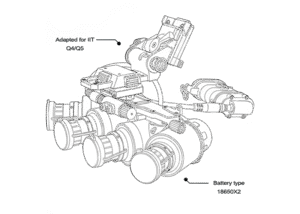
First, check what battery type the device uses. A simple monocular, like a PVS-14 style unit, often uses one AA battery. The battery is easy to replace and widely available.
For binocular systems, power options become more important. Some newer housings use modular power systems. They let users switch between AA, CR123A, or external battery packs as needed.
So if runtime matters, buyers should confirm:
- battery type
- whether external battery packs are supported
- whether the power system is modular
- whether battery replacement is easy in the field
- whether the device includes low-battery indication
A long-runtime device is not only about a big number. It is about whether the power system supports the way the user actually works.
3.2 If You Need Long-Wear Comfort, Check Weight and Balance
Weight is one of the most important specifications for real-world usability. This is especially true for helmet-mounted night vision.
A product may perform well, but if it is too heavy or poorly balanced, it can feel uncomfortable over time. That discomfort can reduce effectiveness even if the image quality is good.
Currently, the weight of night vision devices on the market ranges from 430 to 550 g.:
- Around 300–400 g: usually easier for entry-level monocular use
- Around 430–450 g: strong target for lightweight binocular use
- Over 500 g: may still be acceptable, but comfort needs closer evaluation for long sessions
If the device will be worn on a helmet for patrol or tactical work, weight should not be treated as a small detail. It is part of performance.
3.3 If You Want Easier Future Repair or Upgrades, Check Tube and Lens Compatibility
This is a very practical but often overlooked point. Some buyers focus only on the tube grade, but do not ask whether the housing supports common image tube and lens standards. That can matter a lot later for maintenance, replacement, and product flexibility.
Most modern night vision devices support MX10160 / MX11769 tubes and PVS-14 lenses
Key Parameters: 1× magnification, 40° field of view, and the PVS-14 lens ecosystem.
That means when buyers evaluate a product, they should ask:
- Is it compatible with MX10160 / MX11769tubes?
- Is it compatible with PVS-14 eyepiece and objective lenses?
- Can you replace or upgrade the tube later?
- Is the housing modular enough for easier maintenance?
This matters because a device based on common standards is usually easier to service. It is also easier to upgrade and support over time.
3.4 If You Care About Real Usability, Confirm Field of View and Magnification
For head-mounted night vision goggles, buyers usually do not need unusual optical formats. What matters most is whether the optical system matches normal movement and observation.
Almost all mainstream military night vision binoculars use 1× magnification and a 40° field of view. These values have become the practical standard.
This is useful because it simplifies product selection:
- 1× magnificationis the normal choice for movement and situational awareness
- 40° FOVis the common mainstream standard
- if a product does not match this ecosystem, buyers should ask why
For most users, especially first-time buyers, this means they do not need unusual magnification.
They also do not need exotic optical formats. A practical, standard optical system is usually the better choice.
3.5 If You Need Better Control in Mixed Light, Check Manual Gain and Bright-Light Protection
Not all environments are equally dark. Some users move between shaded areas, urban lighting, low-light outdoor areas, and sudden exposure to bright light. In these situations, system control and protection become important.
One feature to check is manual gain. This allows the user to adjust image brightness according to conditions and personal preference.
Another feature buyers should confirm is bright-light protection or automatic highlight cutoff. The Noctis PVS-14 specifically lists automatic high-light cutoff as a core feature.
For buyers using night vision in mixed or uncertain environments, this is not an optional extra. It is a useful protection feature.
So when comparing models, buyers should ask:
- Does it support manual gain?
- Does it have auto-gatingor strong light protection?
- Is the device designed for changing light conditions or only for stable darkness?
3.6 If You Want a More Practical System, Check Auto Shutoff Features
Auto shutoff functions are very useful in real field use, but many buyers do not think to ask about them.
For example, some binocular night vision devices turn off when stowed.
This can happen by flipping them up or rotating them sideways.
This helps reduce wasted power and improves the user experience.
If these aspects of the user experience are important to you, you should verify the following:
- flip-up auto shutoff
- side-pod shutoff
- low-battery warning
- IR-on indicators
3.7 A Practical Checklist Buyers Can Use
I have compiled a selection of parameters for your reference—not the complete list:
For runtime
- battery type
- estimated runtime
- onboard vs external battery support
- low-battery warning
For comfort
- total weight
- whether the weight is suitable for helmet use
- whether the design is balanced for long wear
For maintenance and upgrades
- MX-10160 / MX-11769 compatibility
- PVS-14 lens compatibility
- replaceable or upgradeable tube support
- modular housing design
For usability
- 1× magnification
- 40° field of view
- manual gain
- flip-up / side-rotation auto shutoff
- bright-light protection or auto high-light cutoff
Once buyers understand these points, the specification sheet becomes much easier to read. It is no longer just a list of numbers. It becomes a practical tool for choosing the right night vision system.
3.8 Read the Product as a System, Not as a Single Number
The most important lesson is simple: do not judge a night vision device by only one specification.
Do not choose only by FOM.
Do not choose only by phosphor color.
Do not choose only by price.
And do not ignore the battery system, weight, compatibility, and protective features.
4. Gen 2+ vs Gen 3
One of the most common questions in the night vision market is whether to choose a Gen 2+ tube or a Gen 3 tube.
At a basic level, Gen 2+ and Gen 3 both belong to the image intensifier night vision category. However, they differ in performance level, cost, and the type of user they are best suited for.
For many buyers, the biggest mistake is assuming that Gen 3 is always the right answer. In reality, the better option depends on budget, application, and performance expectations.
If you want a simple rule, think about it this way: Choose Gen 2+ if your priority is cost control, practical performance, and a lower barrier to entry. Choose Gen 3 if your priority is stronger low-light capability, higher-end performance, and a more premium system. But, the right tube is not the one with the highest label. It is the one that gives the user the right level of performance for the job.
4.2 A Simple Way to Decide
5. How to Avoid Mistakes When Buying Night Vision
By the time buyers reach this stage, they often already understand the basic product differences. They may know the intended use case, the target budget, and the main configuration they are looking for. However, many buying mistakes still happen after that point.
The reason is simple: choosing the right night vision device is not only about choosing the right specifications. It is also about choosing the right supplier, the right service level, and the right purchasing process.
For many buyers, especially first-time buyers, the biggest risk is not always buying the wrong format or the wrong tube. The bigger risk is buying from a supplier who cannot explain the product clearly. The supplier may not support the buyer after the sale. The supplier may not provide stable quality over time.
5.1 For Individual Buyers: Do Not Judge a Supplier by Price Alone
For personal buyers, one of the most common mistakes is assuming that the lowest offer is the best deal.
A lower price may look attractive at first, but night vision is not a simple consumer product.
Buyers often :
pay for more than just the device/for build quality/ for accurate setup/ for product support/ for after-sales service.
If these parts are weak, the lower price may quickly become more expensive in the long run.
A better approach is to ask what the offer actually includes. Does the supplier clearly explain the configuration?
Is the product description detailed and understandable? Are the included accessories, battery options, and support terms clearly stated? If the offer looks cheap but the information is vague, buyers should be careful.
5.2 For Individual Buyers: Confirm Warranty and After-Sales Support
Warranty is one of the most important things to confirm before buying, but many personal buyers do not pay enough attention to it.
A reliable supplier should clearly explain:
- how long the warranty lasts
- what the warranty covers
- what is not covered
- how repair or replacement is handled
- whether technical support is available after delivery
This matters because even a good night vision device may require adjustment guidance, troubleshooting, or parts support later. If the supplier becomes hard to reach after payment, the buyer may have very limited options.
In practical terms, a buyer should not only ask, “Do you offer a warranty?” The better question is, “What happens if there is a problem after I receive the product?”
5.3 For Individual Buyers: Look for Clear Communication, Not Just Sales Language
Another common mistake is trusting suppliers who use strong marketing language but provide weak answers to simple questions.
A trustworthy supplier should be able to explain product differences in a direct and understandable way. If a buyer asks about tube options, battery setup, compatibility, or delivery contents, the answer should be clear.
If the supplier avoids specific questions, changes the explanation repeatedly, or only pushes the most expensive option, that is a warning sign.
Good communication is often one of the strongest signs of a reliable supplier. It shows that the company understands the product and is prepared to support the buyer beyond the first transaction.
5.4 For Wholesale Buyers: Do Not Buy Only What Looks Impressive
Another common mistake is even more prevalent among wholesale buyers. When selecting night-vision devices, many people focus only on product specs and miss how well they fit their market.
In the wholesale business, the so-called “best products” do not always refer to the most high-end items. Rather, it is products whose pricing precisely aligns with end customers’ needs and expectations.
Top products can look very appealing in a product catalog. However, if buyers are price-sensitive, these products often sell slowly.
Conversely, low-cost products may seem easy to sell. But if their quality is unstable or after-sales support is weak, they can cause complaints. They can also damage the brand’s reputation.
Wholesale buyers should think in terms of product structure, not just product features.
5.5 For Wholesale Buyers: Check Whether the Supplier Can Support Repeat Orders
For bulk buyers, consistency matters as much as performance.
A supplier may provide one good sample, but wholesale business depends on whether future orders can maintain similar quality, configuration control, and delivery reliability. This is why distributors should not only evaluate the product itself. They should also evaluate whether the supplier is capable of long-term cooperation.
Before placing larger orders, wholesale buyers should confirm:
- whether product specifications can remain stable across batches
- whether packaging and configuration can be standardized
- whether lead times are clear
- whether replacement or support procedures are defined
- whether the supplier can handle ongoing supply, not just one shipment
This is especially important for resellers building their own brand reputation. A weak supplier can damage customer trust very quickly.
5.6 For Wholesale Buyers: Evaluate the Supplier’s Business Fit
Not every supplier is suitable for every type of buyer.
Some suppliers are better for small-volume retail-style transactions. Others are better for long-term OEM, distribution, or project-based cooperation. A wholesale buyer should look for a supplier whose business model fits the intended partnership.
For example, can the supplier support different configuration levels for different market segments? Can they communicate clearly about packaging, branding, documentation, and product positioning? Can they help the buyer build a product line instead of offering only one fixed model?
A supplier that understands business cooperation is often far more valuable than one that simply provides a product list.
5.7 A Safer Buying Approach
The safest way to avoid mistakes is to treat the buying decision as two connected choices:
First, choose the right night vision product for the application.
Second, choose the right supplier for the purchase.
For personal buyers, this means focusing on clear communication, real warranty support, and realistic service.
For wholesale buyers, this means focusing on product consistency, supply reliability, business fit, and long-term cooperation potential.
A successful purchase depends on both.
5.8 The Right Seller Reduces Risk
In the end, many buying mistakes happen because buyers trust the wrong seller.
A reliable supplier helps buyers make better decisions, understand the configuration more clearly, and solve problems more smoothly. That kind of support is often more valuable than a small difference in price alone.
The right seller does not only deliver a device. They reduce risk and improve the full buying experience.
6.Conclusion
By this point, you should already have a much clearer idea of how to choose the right night vision device for your needs.
However, in real purchasing situations, buyers still often run into practical problems that go beyond product specifications.
- Some are unsure whether they are paying for features they do not really need
- Some underestimate the total system cost beyond the main unit
- Some struggle to judge whether a seller is truly reliable in terms of communication, warranty, and after-sales support.
For wholesale buyers, the concerns can go even further
including product consistency, lead time, repeat-order stability, and whether the supplier is suitable for long-term cooperation.
How to avoided these?
You need to do your homework before making a purchase:
understand all the costs associated with night vision equipment and identify a suitable supplier.
Of course, no single guide can cover every situation a buyer may face.
But the ideas in this article can help you reduce risk and avoid common mistakes.
They can also help you make a more confident night vision buying decision.